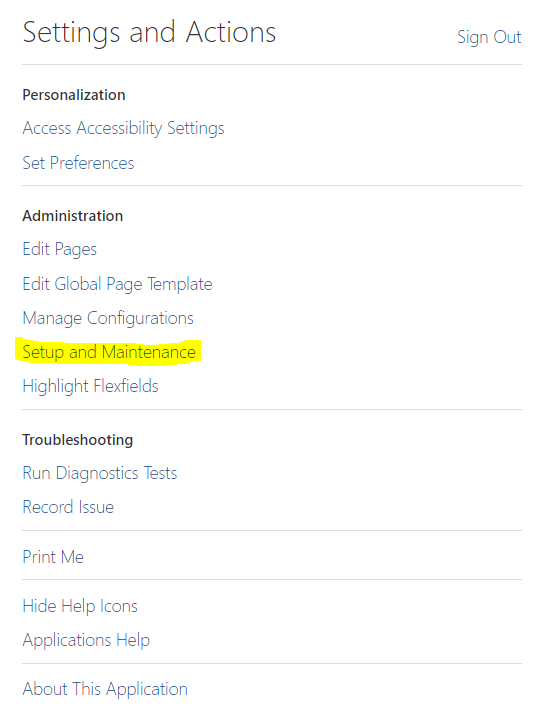
Where to download The ADFdi add-in for Excel runs on Microsoft Windows inside Microsoft Excel
https://<hostname>:<portnumber> /fscmUI/adfdiRemoteServlet?excel-addin-installer-all-users
Where to download The ADFdi add-in for Excel runs on Microsoft Windows inside Microsoft Excel
https://<hostname>:<portnumber> /fscmUI/adfdiRemoteServlet?excel-addin-installer-all-users
_B - base table. It holds the main details of the object in question and it implies that there is also a _TL table for it. You'd never find a _B table without a _TL table. the primary key is the id column.
_TL - translatable table. Holds the translated names/descriptions for base objects. will have one row per installed language. linked to the base table by the _id column. Doesn't always imply that there is a _B as its base data could also be in a _F table or a table without postfix. The primary key is the id column plus the language column.
_F - date effective table. Tends to exist only in HR and it holds objects that are date effective. It means the primary key is the combination of the ID column, effective start date and effective end date. there is only 1 row per ID for any date, but you can have multiple rows for the same id over time. Some _F columns come with a matching _TL column, too.
_VL - translatable view. It's not a table, but the view that represents the join of the base table and the TL table using the user's session language. You can assume that almost all _TL tables come paired with a _VL view.
_M - multiple changes per date table. Like a _F table, but it allows rows to start and end on the same day. There is only one such table per_all_assignments_m, and it has additionally the effective_sequence in the primary key.
_DN - denormalised table: usually just a simplification of another table that holds hierarchies or trees of some kind. The denormalised tables are populated by ESS processes and hold the flattened hierarchy that has direct links between all nodes and their distance. Those are used e.g. for security profiles based on the manager hierarchy.
source: oracle
Use: APEX_JSON.write('P_INVOICE_TRACKING', '', true);
Result: "P_INVOICE_TRACKING":null
Use: APEX_JSON.write_raw('P_INVOICE_NUMBER', '"'||r_header.sppd_code||'"');
Result: "P_INVOICE_NUMBER":"0134/XYZ/084/RS/2021"
Here how to get SOURCE SYSTEM OWNER on HDL process


SELECT *
FROM fnd_lookup_values
WHERE lookup_type = 'HRC_SOURCE_SYSTEM_OWNER'

  procedure send_email_test(
    p_from    varchar2 default 'info@yourdomain.com'
  , p_to      varchar2
  , p_subject varchar2 default 'Email test'
  )
  as
    l_body      clob;
  begin

    l_body := 'Thank you for your interest in the APEX_MAIL package.'||utl_tcp.crlf;
    l_body := l_body ||'  Sincerely,'||utl_tcp.crlf;
    l_body := l_body ||'  The APEX Dev Team'||utl_tcp.crlf;
    apex_mail.send(
        p_to       => p_to,   -- change to your email address
        p_from     => p_from, -- change to a real senders email address
        p_body     => l_body,
        p_subj     => p_subject
    );
        APEX_MAIL.PUSH_QUEUE;
  end send_email_test;
unzip apex_18.1_en.zip
mv /home/oracle/tmp/apex/ /u01/app/oracle/product/apex/18.1.0.00.45/
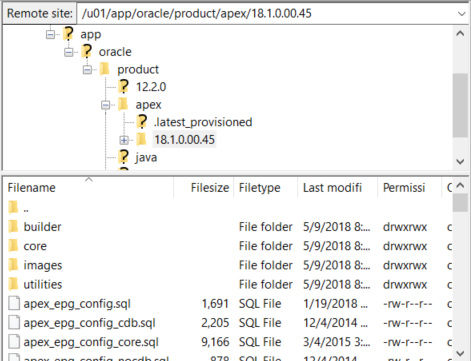
sqlplus /nolog
SQL> CONNECT ORDS_PUBLIC_USER
Password:
Connected.
SQL>
ALTER SESSION SET CONTAINER=PDB1;
@dbcsins.sql SYSAUX SYSAUX TEMP /i/18.1.0.00.45/ <ORDS_PUBLIC_USER_PASSWORD>
SELECT VERSION, STATUS, SCHEMA FROM DBA_REGISTRY WHERE COMP_ID = 'APEX';
ln -sfn /u01/app/oracle/product/apex/18.1.0.00.45/images/ /u01/app/oracle/product/ords/conf/ords/standalone/doc_root/i/18.1.0.00.45
$ sudo -s
# cd /var/opt/oracle/ocde/assistants/ords
# ./ords -out="/var/opt/oracle/ocde/res/ords.out" -ords_action="configure_apex"
# /etc/init.d/ords restart


declare
  r_data EMP_PDF%rowtype;
BEGIN
  select * into r_data
    from emp_pdf
   where empno = :P4_EMPNO;
    sys.htp.init;
    sys.owa_util.mime_header( r_data.mimetype, FALSE);
    sys.htp.p('Content-length: ' || sys.dbms_lob.getlength( r_data.pdf_data ));
    sys.htp.p('Content-Disposition: inline; filename='||r_data.filename );
    -- tell the browser to cache for one hour, adjust as necessary
    sys.htp.p('Cache-Control: max-age=3600');
    sys.owa_util.http_header_close;

    sys.wpg_docload.download_file(r_data.pdf_data);
    apex_application.stop_apex_engine;
exception when others then
    sys.htp.prn('error: '||sqlerrm);
    apex_application.stop_apex_engine;
END;


Select *
  from APEX_MAIL_QUEUE;
create or replace procedure set_apex_context (
  p_app_id in number
) as
begin
 FOR c1 IN (
   SELECT workspace_id
    FROM apex_applications
   WHERE application_id = p_app_id
  )
 LOOP
   apex_util.set_security_group_id(p_security_group_id => c1.workspace_id);
 END LOOP;
end set_apex_context;
execute set_apex_context (140); --i40 is app id
Select *
  from APEX_MAIL_QUEUE;


ALTER TABLESPACE tablespace_name OFFLINE;
ALTER TABLESPACE tablespace_name
RENAME DATAFILE 'fully qualified path to original data file name'
TO 'new or original fully qualified path to new or original data file name';
ALTER TABLESPACE tablespace_name ONLINE;
recover datafile 'new fully qualified path to original data file name'


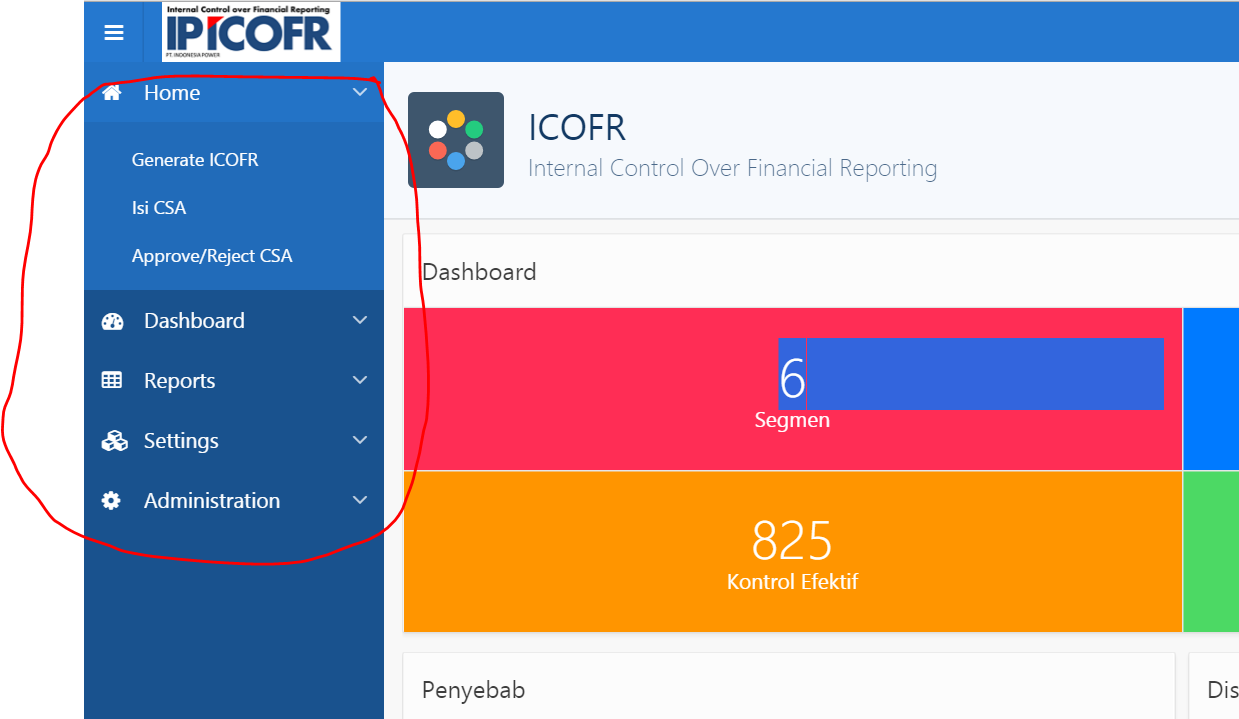
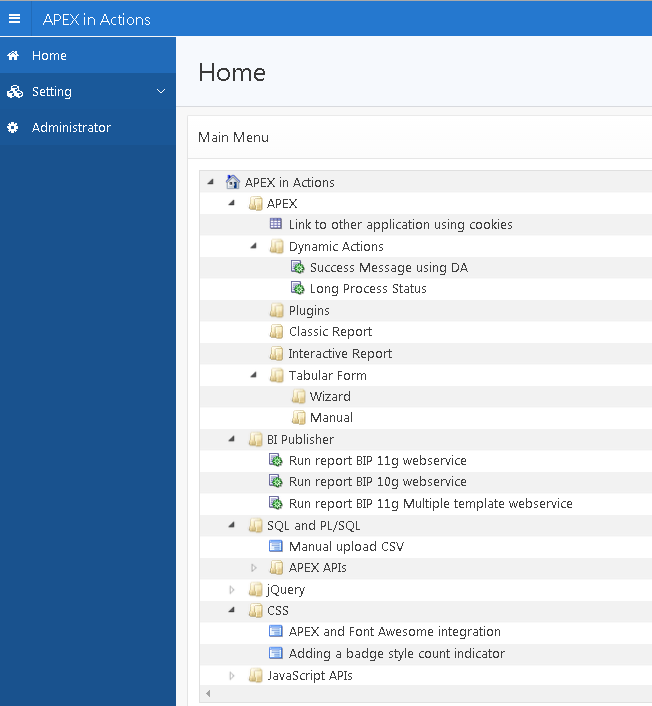
 select case when connect_by_isleaf = 1 then 0
            when level = 1             then 1
            else                           -1
        end as status
      , level
      , entry_text as title
      , entry_image as icon
      , list_entry_id as value
      , null as tooltip
      , null as link
   from APEX_APPLICATION_LIST_ENTRIES
  where application_name = 'APPS_NAME'
    and list_name = 'List name'
  start with list_entry_parent_id is null
connect by
  prior list_entry_id = list_entry_parent_id
  order siblings by display_sequence





function(){
  openModal('addDept');
  gBackground.off('click');
}

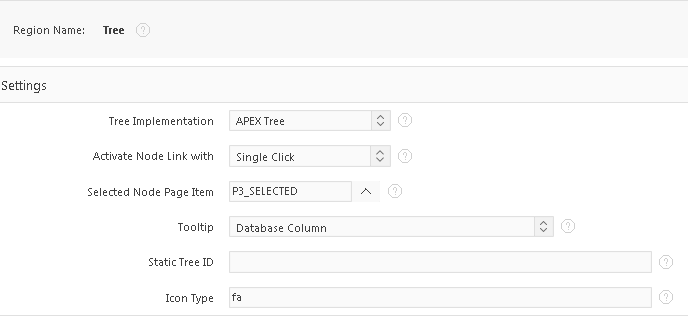

 select case
          when connect_by_isleaf = 1 then 0
          when level = 1             then 1
          else                           -1
        end as status
      , level
      , m.description as title
      , case
          when m.status = 'X' then 'fa-home fa-lg'
          when m.status = 'M' then 'fa-folder-open-o fa-lg'
          when m.status = 'F' then 'fa-book fa-lg'
          when m.status = 'R' then 'fa-table fa-lg'
          when m.status = 'T' then 'fa-tasks fa-lg'
          when m.status = 'C' then 'fa-bar-chart fa-lg'
          when m.status = 'S' then 'fa-cubes fa-lg'
        end as icon
      , m.id as value
      , m.tooltip as tooltip
      , 'f?p=&APP_ID.:&APP_PAGE_ID.:&SESSION.::::P3_ID,P3_SELECTED:'||m.id||','||m.id as link
   from my_menu m
  start with m.status = 'X'
connect by prior m.id = m.parent_id
  order siblings by m.SEQ
http://query.yahooapis.com/v1/public/yql?q=select * from yahoo.finance.xchange where pair in ("USDIDR")&env=store://datatables.org/alltableswithkeys
create or replace function get_yahoo_rate
return number
is

/******************************************************************************
   NAME:       get_yahoo_rate
   PURPOSE:    get latest USD-IDR rate from Yahoo finance exchange

   REVISIONS:
   Ver        Date        Author           Description
   ---------  ----------  ---------------  ------------------------------------
   1.0        10/10/2014   Lutfi Hedir     1. Created this function.

******************************************************************************/
  l_xml xmltype;
  l_yahoo_uri constant varchar2(500) := 'http://query.yahooapis.com/v1/public/yql?q=select%20*%20from%20yahoo.finance.xchange%20where%20pair%20in%20(%22USDIDR%22)&env=store://datatables.org/alltableswithkeys';
  l_rate      varchar2(500);
  l_rate_n    number(10);
begin
  -- get xml data
  l_xml := xmltype(utl_http.request(l_yahoo_uri));
  -- extract rate value from xml data
  select extractvalue(l_xml, '/query/results/rate/Rate/text()') into l_rate
    from dual;
  -- convert to number
  l_rate_n := to_number(REGEXP_SUBSTR(l_rate,'[0-9]+'));

  return l_rate_n;

end get_yahoo_rate;
/